I was born in Albania. I grew up fast — leaving home at fourteen, making my way to Greece, then Italy, then the world. I lived in Rome for years, fell in love with food, with people, with the idea that a great meal could make a stranger feel like family.
I came to America and kept moving. I loaded my kids into an RV and drove across the country — from coast to coast, state to state, sleeping under different skies, learning that home isn't a place. It's the people you're with and the food you make together.
Eventually the road led me to Pasco. And by God's grace, Best Pizza Ever was born — out of a commissary kitchen, one man, one dream, and a dough recipe that carries every mile I've traveled.
Every pizza I make carries a little bit of Albania, a little bit of Rome, and a whole lot of the American road. I hope you taste it.
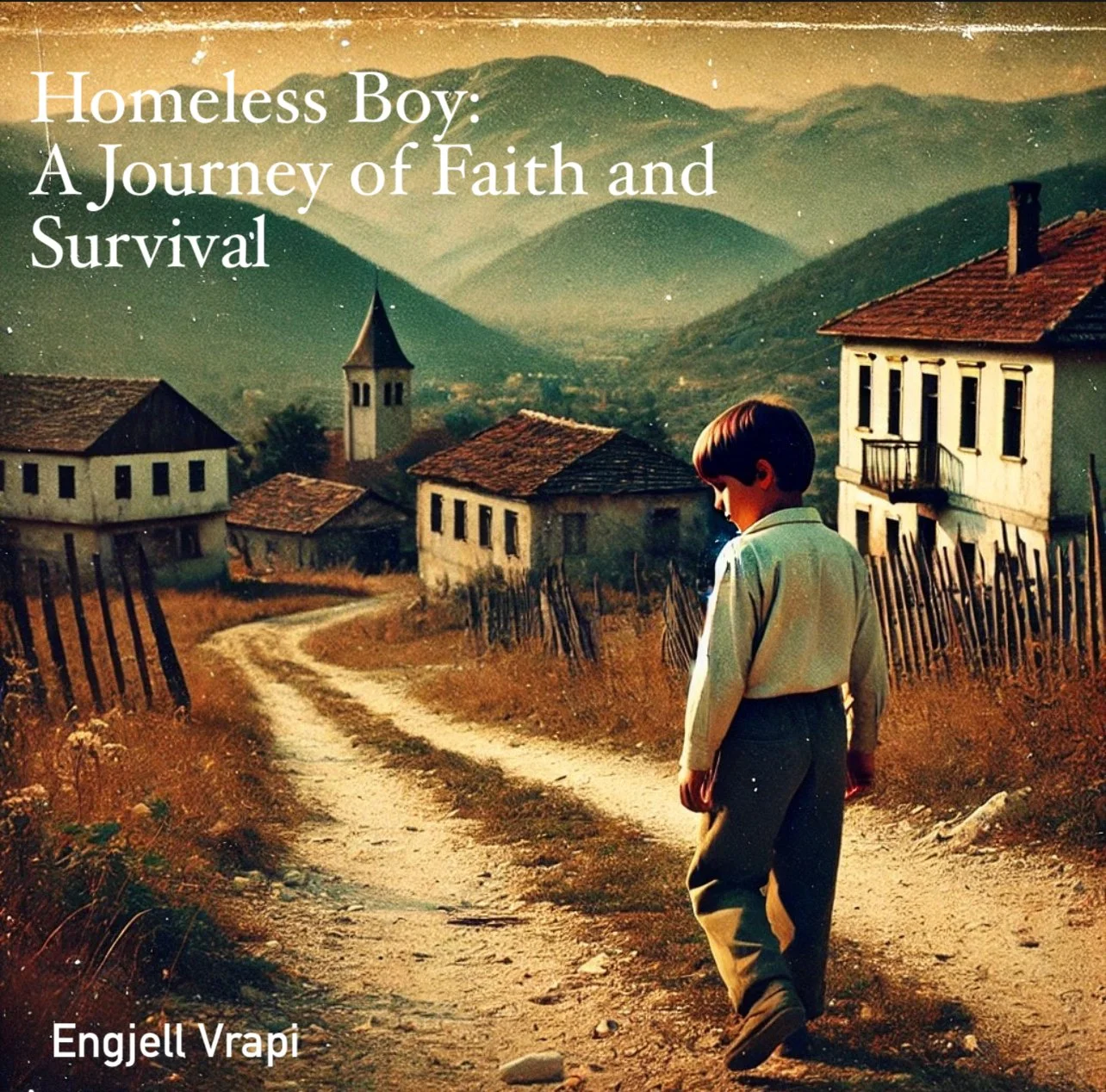
the Homeless Boy
THE HOMELESS BOY — A Memoir
Engjell Vrapi
Chapter One: When the Wall Fell
I was twelve when everything changed.
Not just in Albania. In me.
My grandfather was the village doctor. My father worked oil by day and sewed cotton pants by night. We were good people. Muslim by birth, not by choice — the way most things were in communist Albania. You did not choose your religion. You inherited it like a name.
God was illegal. Churches were warehouses. Mosques were barns. Nobody talked about faith — not openly, not even in whispers. I did not know what a Bible looked like. I just knew I had questions. Big ones. And nowhere to put them.
Then communism fell. Loud, sudden, messy — like a brittle tree crashing in the middle of the night. And in the chaos that followed, something unexpected appeared on our streets.
Missionaries. People from faraway places with strange accents and kind eyes. They handed out little papers. They smiled at you like they meant it.
We called them the Jesus people.
In a small town where everyone knows everyone, that was enough to make you an outcast. Kids made fun of them. Adults whispered. My grandfather would have had something to say, I am sure.
But I was drawn to them. I do not know why. I just was.
One of them invited me to a gathering. It was held in the basement of a house on the edge of town. Folding chairs. An old rug. A guitar with only five strings.
I was scared walking in. Scared someone would see me. Scared of what they would tell my family.
But I went anyway.
A man stood up and spoke Albanian — simple, clear words, not like the way grown-ups usually talked. And then he said something I had never heard before in my life.
"God loves you. Not because of what you have done. But because He made you."
I sat still. My legs were trembling.
Nobody had ever said that to me. Not like that. Not as if they meant me specifically — me, a twelve year old boy from a small Albanian town who did not know anything.
He read from a book I had never seen. He said Jesus died for our sins. He said Jesus was alive.
I did not raise my hand. I did not walk forward. I just whispered something in my heart. Three words.
Jesus, save me.
I walked home that night under a sky full of stars. Same dirt roads I had walked a hundred times. Same trees. Same silence.
But everything looked different.
I did not have words for it then. I still struggle to explain it now. I just know that something shifted inside me that night — something I have never been able to unshift, no matter how hard life tried.
I was still a boy in a country clawing its way out of darkness.
But for the first time, I was not alone.
That night they gave me a small blue New Testament. Albanian. Dhjata e Re.
It is on the dashboard of my Suburban right now.
It has been across borders, across oceans, through kitchens and hospital rooms and the backs of trucks. It has survived everything I survived.
It is the one thing I have never lost.
Chapter Two: The First Snow
My earliest memory is cold.
Not the cold of a winter coat and a warm house waiting for you. The cold of a country that did not waste heat on children. The cold of frozen creek beds and bare hands and a rubber container hanging by the fence at my grandparents' house that we called the mustlluk.
It was a small thing. Just a container filled with water, hung on the fence with a little spigot at the bottom. You turned the spigot and the water came out. In summer it was lukewarm and fine. In winter it was so cold it made your teeth ache just to look at it.
Every morning we washed our faces there. Outside. In the freezing air. No warm water. No bathroom sink. Just the mustlluk and the winter and your own breath making clouds in front of you.
Nobody complained. This was just what morning was.
I was four or five years old the first time it snowed the way I remember. Not a dusting. A real snow — the kind that changes the world overnight. You go to bed in one place and wake up in another. Everything you knew is white and quiet and completely new.
I stood at the door of my grandparents' house and could not move.
I had never seen anything like it.
The creek behind the house was frozen. Not just icy — solid. You could walk on it. We did. A group of us, the neighborhood children, sliding across it in our shoes, falling, laughing, getting up and doing it again. Nobody told us to come inside. Nobody worried. Children were left to figure out the world on their own most of the time.
The cold did not bother us. We were too young to know we were supposed to be uncomfortable. We just knew the creek was frozen and that was extraordinary and we were going to be on it until someone made us stop.
My grandparents' house was made of mud. Real mud — packed and dried and layered until it became walls. It sounds fragile. It was not. Those walls were thick enough to hold the cold out in winter and the heat out in summer. They smelled like earth and old wood and something I have never been able to name — the specific smell of a house that has held a family for generations.
The well was in the yard. A real well, the kind with a rope and a bucket. My grandmother would lower the bucket and bring it back up full, the water cold and clear and tasting like the ground itself.
And by the fence — the mustlluk. Our morning ritual. Our cold water on cold faces. Our way of waking up.
I think about that mustlluk sometimes now when I am in my Suburban in Pasco and I turn on the tap and warm water comes out immediately. The distance between that rubber container on a fence in Roskovec and a heated vehicle in Washington State is not just geography. It is a whole life.
But the cold — the specific cold of those Albanian winters, the frozen creek, the mustlluk, the breath in clouds before you — that I carry with me still.
Some things do not wash off no matter how warm the water gets.
Chapter Three: The Mud House
My grandfather's house was made of mud.
Real mud — packed and dried and layered until it became walls thick enough to hold a family for generations. From the outside it looked like it could collapse in a heavy rain. From the inside it felt like a fortress. Those walls were cool in summer and held warmth in winter. They smelled like earth and old wood and something else I have never been able to name — the specific smell of a house that has absorbed decades of cooking and argument and silence and prayer.
My grandfather Refit was the village doctor. In Roskovec that meant something. People traveled from villages away for him. He performed circumcisions. He knew the old remedies and the new ones. He had strong hands, steady hands, and a voice that filled a room before he entered it.
He also worked with leeches.
I watched him do it more than once. A patient would come to the house — someone with high blood pressure, someone with a headache that would not leave, someone whose blood needed drawing the old way. My grandfather would bring out the leeches, living things, dark and small, and place them on the skin. They did their work slowly. Quietly. Drawing out what needed to come out.
It sounds medieval now. In Roskovec in the 1980s it was medicine.
My grandmother Habibe assisted him. She was not squeamish about any of it. She handed him what he needed, prepared the patient, cleaned up after. She was his partner in the practical work of keeping people alive. The leeches, the bandages, the herbs — she knew all of it.
For the cases where blood needed to be drawn differently, my grandfather used a shaving razor. He sharpened it on a leather strip — back and forth, slow and deliberate, the sound of it particular and precise — and then he would draw the razor lightly across the forehead. Just enough to let the blood come. Just enough to release what the body was holding too tightly.
I watched his hands during those moments. They never shook.
Most people were scared of him. I was too, sometimes.
But I was also his favorite. He would call me to him and I would go. I changed his diapers when he was paralyzed — oil soaked foil, because that is what was available. I helped him when he could not help himself. I was small and quiet and I asked for nothing.
I learned that from him without him ever saying a word. You do not ask. You endure. You serve. You stay quiet and you carry what needs carrying.
There was a fig tree in the yard. I remember the figs more than almost anything else from that house — the way they split open in summer, the sweetness that felt almost violent after months of plain food. My grandmother would pick them and we would eat them standing in the yard, the juice running down our chins, and for a few minutes everything in that complicated house felt simple.
That was the mud house. That was where I came from.
Chapter Four: Suk — My Mother's Story
My mother came from a village called Suk.
Smaller than Roskovec. Quieter. The kind of place where your family name was your whole identity and everyone knew exactly who you were before you opened your mouth.
She was shown my father's face once. One meeting. Chaperoned. Formal. The two of them sitting across from each other with family watching from every direction.
Her parents said no.
Whatever she saw in that meeting — or whatever she sensed, the way mothers sense things before they have words for them — she called it off. She did not want this marriage for her daughter.
But then my grandfather came to Suk.
He did not send a message. He did not summon them. He came himself, with my father's sister Keze — his third daughter, the one he was closest to — and he traveled to that small village and he sat down on the rrogoz.
The rrogoz is a mat woven from straw. Every Albanian home had one. You put it on the floor and you sat on it when you wanted to show respect — when you wanted to say, without words, I am coming to your level. I am not above this. I am sitting in your house on your mat and I am asking.
My grandfather Refit — the village doctor, the man whose voice filled rooms before he entered them, the man people were scared of — sat down on a straw mat in a village smaller than the one he came from and he asked.
My father's family was poor. People did not always know that from the outside. The Vrapi name carried weight. My great-grandfather had ridden a white horse. But inside the house there were nima — wooden bed frames strung with gomërdare, strips cut from the inside of old tires and stretched across the frame like springs. Not real springs. Tire rubber. Because that is what was available. Because you made do with what you had and you called it a bed and you slept in it and you did not complain.
Two poor families. A straw mat. A man with a strong name and wooden beds at home sitting across from a family that had already said no.
Aunt Keze told my mother years later what she had noticed that day in Suk.
While the men sat on the rrogoz and talked, Keze had quietly lifted the corner of the bedding in the room where she was sitting. Just a small gesture. A woman's way of reading a house.
The sheets were clean.
In a village that poor, with nothing to spare, the sheets were clean.
She told my father's family: this is a good family. Poor but clean. That means something.
My mother never knew she had been evaluated that way. She found out long after the wedding, long after the mud house, long after the boiling water pot.
But I think about it sometimes. A young woman in Suk who had no idea that her clean sheets were the thing that brought my grandfather to her door. That her mother's discipline and her family's dignity — expressed in nothing more than a piece of clean linen — was what tipped the decision.
You never know which small thing will change everything.
My mother left Suk and moved into the mud house and became Nusia. The bride. She was not asked if she wanted to go. She was told the family had decided.
Nobody told her about Ballsh. Nobody mentioned the fracture in my father's mind. Nobody said this man has been carrying something broken since he was seventeen years old and it will fall on you.
She found out the way you find out everything in that kind of marriage. Slowly. After it was too late to leave.
She never left anyway.
Not because she could not. But because she was built from the same thing as that rrogoz — plain material, pressed together under weight, made strong by the pressure of everything that tried to flatten it.
My mother came from Suk with nothing but her name and her hands and her will.
That was enough. It was always enough.
Chapter Five: The Metal Train
Uncle Fatos came to visit with a metal toy train.
He was nineteen years old. My mother's youngest brother. Still in school in Fier at the time — just a teenager, really, not yet the man who would later cross into Greece with cowboy boots and stories and a promise of a supermarket job.
That came later. In 1989 he was just Fatos. A young man from Suk visiting his sister's family in Roskovec, and he brought something for me.
I do not know where he found it. What mattered was that he produced it — a metal toy train that caught the light and made me stop breathing for a moment.
It had real metal wheels. They turned. You could push it across the floor and feel the weight of it in your hands — real weight, not plastic, not cardboard, not something improvised.
It was the most beautiful thing I had ever owned.
I kept it under my bed at night. I played with it carefully, the way you handle something you know could be taken away.
My mother watched him give it to me. Her youngest brother, nineteen years old, handing her five year old son a metal train. I wonder what she felt. Pride in him maybe. The particular tenderness of
watching someone you love be generous.
Fatos would leave for military service after school. Then after the military, somewhere around 1994 or 1995, he would cross into Greece for the first time. He would come back with cowboy boots and Greek songs and stories. He would go back again. He would get deported. He would go back again. He would eventually take me with him on a promise of a supermarket job that never existed.
But in 1989 none of that had happened yet.
In 1989 he was just my young uncle from Suk who came to visit and brought me something beautiful.
I still remember the weight of it.
Heavy. Real. Mine.
Some people give you beautiful things long before you understand who they will become. You learn the rest later. When you are five years old and your nineteen year old uncle puts a metal train in your hands, all you know is the train.
Chapter Six: My Father
My father was quiet.
Not peaceful quiet. Absence quiet. The kind of silence that fills a room and makes everyone walk carefully around it.
He worked long days at the oil fields in Marinëz. He would leave before we woke up and come home smelling of crude and exhaustion. At work he stayed late, picked up other men's jobs, stayed until the light was gone. I understand now what that was — a man filling his hours with labor so he did not have to sit inside his own mind.
At lunchtime he ate alone.
My grandmother Habibe stretched everything. Bread with eggs and extra flour — as much flour as the dough could hold and still be bread. There were many mouths. You made do. But my father could not let his coworkers see what was in his tin. A proud man from the Vrapi family, the doctor's son, the man who worked harder than anyone — he could not let them see the lunch that poverty had made. So he turned away. He ate alone. He carried that dignity the only way he knew how.
After work he went to Sadush.
Sadush was his uncle on his father's side. Fifteen children of his own plus a grandchild he was raising. A barber with a shop that smelled of raki and cigarettes and the particular warmth of men who have nowhere better to be. Sadush called my father his favorite nephew. He made kukurec — lamb intestines wrapped and roasted on a spit, an old Turkish dish that smelled like everything good and dangerous at once. They would sit together and drink raki that my father was not supposed to drink. With his condition, the doctors had said no. Sadush did not care about conditions. Sadush cared about his favorite nephew sitting across from him in the barbershop after a long day.
Sadush was bad news for my father. I knew that even as a child without having words for it.
When my father came home he was different. Not drunk exactly. Just more present in a way that was worse than his absence. I learned to read the apartment the moment I walked in — the quality of the silence, the position of things, whether my mother's movements were quick or slow. I learned to make myself invisible.
There was a sewing machine in the apartment. It had belonged to my uncle Namik who bought it but never learned to sew. My father had inherited it and taught himself. In the evenings men would come with fabric and measurements and my father would stay up late making pants. Cotton pants, the kind everyone needed, the kind that kept us fed when the oil fields did not pay enough. The sound of that sewing machine at night — the rhythm of it, steady and relentless — is one of the sounds I most associate with him. Working. Always working. As if stillness was the enemy.
He beat me twice.
The first time I was playing in the rain with Ermela. He called from the balcony of our second floor apartment — come inside. I knew from the way he said it that what was waiting was not good. I went up the stairs and walked through the door and he hit me across the face so hard I saw red and then stars circling my head like a cartoon. One blow. He did not need more than one.
The second time was worse.
Ermela and I were fighting the way siblings fight — the kind of fight that has no real beginning and no real ending, just energy that needs somewhere to go. I pushed her. She fell against the metal bed frame and her thigh was punctured. Blood.
That bed. I need to tell you about that bed.
My grandfather Ramis had carried it on his back all the way from Donofrosa. A metal bed frame, carried by a man on his own back, because my older brother Buran had died of pneumonia at six months of age. He had been sleeping between two chairs that my grandmother Habibe had pushed together to make something like a cradle. There was no bed. So Buran slept between chairs and caught cold and died and after that my grandfather put a bed on his back and walked.
That bed was in our apartment. Ermela slept in it. And I pushed her into it and her thigh split open against the frame.
My father did not use his hand that time.
He found a copper pipe — about a quarter inch thick, the kind used for plumbing — and he hit my thigh with it. Once. He did not hold back his anger or his strength. I have never forgotten the specific pain of that pipe on bone. The way it went past hurt and into something else entirely.
He was not a cruel man. He was a broken one. There is a difference and it matters.
The breaking happened in Berat.
He had developed ulcers — years of oil fields and raki and worry had eaten through his stomach lining. The surgery was arranged. Sadush knew the doctor and brought a whole roasted lamb as payment — that was how things worked in Albania then. A favor, a gift, a connection. The lamb was enough to get the surgery done.
But in the examination Sadush did not mention Vlora. He did not mention the mental institution where my father had been sent at seventeen after the affair at the oil company in Ballsh — the arrest, the shame, the fear of his own father, the fracture in his mind that never fully healed. Sadush probably did not remember. Or he was drunk. Or he thought it was not relevant. Whatever the reason — he said nothing.
So the doctors put my father under full body anesthesia without knowing what they were putting it into.
My father woke up during surgery.
He pulled out his own tubes. He got up from the operating table. He walked through that hospital in Berat like a man who had crossed to the other side of something and could not find his way back.
He came home different.
We did not recognize him.
The man who had been quietly terrifying became openly terrifying. He made an axe by hand and kept it by the door. He told us stories about men who had done terrible things to their families and never been punished for it — told them the way you tell a story to make sure the listener understands what you are capable of. He was physical with my mother. He terrorized us.
I had been scared of my father before Berat.
After Berat I was terrified.
They took him to the hospital. We visited him at the park during visitations and he hit my mother there in front of us in the open air with other families watching. He would come home medicated and quiet and then the medication would shift and the cycle would begin again.
This is my father.
Not the monster. Not the villain. A man who ate his lunch alone so nobody would see his poverty. A man who carried a family on a sewing machine at midnight. A man whose mind was broken by a system that never gave him a chance to heal — not after Ballsh, not after Berat, not after the anesthesia that nobody warned the doctors about because the one person who knew was too drunk to remember.
He died in 2024. His mind had gone before his body did — the fog came first, then the physical decline, then the end. My mother cared for him in his last months. I was not there.
The last time he saw me I had black eyes from New Year's Eve.
He saw me broken.
I hope he is with Jesus now.
God have mercy on his soul.
He was a good man.
Even Kaleigh said that.
Chapter Seven: My sister Mela
Her name means apple in Italian. We called her Mela — short for Ermela — and there was something fitting about that. Something small and round and sweet, easily bruised.
I have no memories of my sister from the mud house. That time is sealed away somewhere I cannot reach. But the apartment building — that I remember. It was just the two of us there, Mela and me, and we loved each other the way siblings do when they have no choice — fiercely and with great irritation.
She had her world and I had mine, except I did not really have mine. The apartment complex was full of girls. A whole courtyard of them. The only other boys were younger than me, too young to be useful, so I did what any proud Albanian boy would do — I went back to the mama house to find my cousins. Nardi, the one with the broken neck. The others. We were close enough in age that it worked.
Sometimes I came back and joined the girls in the courtyard. Jump rope. Whatever they were playing. I was not too proud for it when loneliness made the choice. But I was always watching the street. What if someone from school sees me? A few times they did. Someone snitched. I heard about it later — Engjell was playing with girls. I would shrug. I had no choice.
Mela was about ten when she came home one day different. Her classmates had found something — aurch meeting in a basement somewhere nearby. They had pulled her in and she had gone willingly. And then she pulled me in.
I was twelve years old the first time I walked down those basement stairs. Communist Albania. Faith practiced in secret. But Mela had gone and so I went. That is how it works with sisters. They open a door and you walk through it without fully understanding that your life is about to change.
I was fourteen when I left for Greece with Yzni. Just like that — Mela was there and then I was gone. Greece. Italy. Rome. A new life assembled from nothing in a language I was still learning.
For four years I could not go back. I missed my family the way you miss something that lives inside your chest — a constant low ache that you learn to carry because you have no other choice. Albania was there and I was here and the distance between us was made of money I did not yet have and borders that did not care about missing your sister.
But in 2004 I went back for her.
I had saved 4,000 euros — not a small amount for a young Albanian immigrant still finding his footing in Rome. I used every euro of it as a guarantor so Mela could come to Rome and study at La Sapienza, one of the oldest universities in the world. I did not use that money for myself. I used it to carry my sister across the same water I had crossed ten years before. She came. She studied. She built her life in Rome — the city that had given me mine.
That is the thing about Mela. We do not speak every day. We do not need to. But when it matters most she finds her way to you.
In 2023 she got word that something was wrong. She did not wait for details. She packed a bag — probably a sensible bag, nothing dramatic — and she came. Not because someone called her. Because she is Mela and that is what she does.
She found me unconscious.
I woke up in the ambulance. The first face I saw was my sister's.
In 2004 I crossed an ocean to bring her to Rome. In 2023 she crossed an ocean to bring me back.
I do not tell her enough how much that means. This is me telling her now.
Chapter Eight: The Basement Church
His name was Ilir. He came from Libofsha — a small village outside Roskovec — and he had gone to the capital to study and to find God and to come back with fire in his chest. Someone was paying him a hundred dollars a month to plant a church in our town. A hundred dollars a month to carry the gospel into communist soil that had spent decades trying to kill it.
He did it.
Mela found it first — or her classmates found it and dragged her in. And then she dragged me. That is how I ended up walking down those basement stairs at twelve years old. A boy who had no business being interested in anything holy, going because his little sister went. That is how most people find faith. Not through argument or evidence. Through someone they love opening a door.
The basement grew. What started as a handful of people meeting in secret became thirty, forty people squeezed into an actual building. I remember the summers most vividly — all those bodies pressing together in the heat, sweating through their shirts, singing anyway. Sweat and worship. The windows fogged. The ceiling low. Nobody cared. When the Spirit moves in a room no one is thinking about the temperature.
I went almost every day. Not because I was holy. Because I was twelve and running out of good options.
Before the church I had started spending time with the wrong boys from school. My classmates. The kind of crowd that leads somewhere you do not want to end up. The church pulled me away from all of that without making a production of it. It just gave me somewhere else to be.
I remember one night before I had found the church — or before Mela dragged me to it — I came home at ten past ten. My curfew was ten o'clock. Ten minutes late and my parents met me at the door and I was out. Kicked out onto the street in the dark.
I walked to the bus station. Our bus station. The one visible from my parents' bedroom window. I sat there in the dark and waited. I could see the curtains move — they were watching me from behind the glass, pretending not to. A father and mother watching their son sit alone at a bus stop in the night, stubborn on both sides of the curtain.
I stayed there for a while. Then I went back inside. They told me I would never do that again. They were right. I never did.
Pastor Ilir from Libofsha gave me a reason to come home on time. A reason to be somewhere good when the night got dark and the wrong boys were calling. The man with a hundred dollars a month and a fire in his chest probably never knew what he gave a twelve year old boy from Roskovec.
But I know.
Chapter Nine: My brother Buran — The Bed from Donofrosa
Before I was born there was another child.
His name was Buran. My brother. He lived six months and then he was gone — taken by pneumonia in a time and place where pneumonia still took children. My mother buried a son before she had me. That is the weight she carried into my birth. That is the shadow that fell across my first breath.
I did not know Buran. I only know his absence — the way a family carries a missing child without ever fully naming it. A quietness. A careful love. A grandmother who held me a little tighter because she had learned what it meant to let go too soon.
When my mother was expecting me my grandfather Ramis decided something. He decided that this child — this next child — would not sleep on the floor. Would not make do. Would have a proper bed.
So he went to Donofrosa.
It is a small village. The kind of place that does not appear on maps that matter. But Ramis knew where to go because Ramis always knew where to go. He had spent his life working under communism — driving one of those old Soviet tractors with chains instead of tires, the kind that looked like a tank crawling through Albanian mud. A man who carried tractor parts on his back across miles of rough country thought nothing of carrying a bed.
He found one in Donofrosa. A small child's bed — the kind that comes apart so it can be moved. He bought it with money he probably got from selling a lamb or a young goat at the market. Not because his family was rich. They were poorer than my father's family. But they did not care about money the way some people do. They cared about their daughter. They cared about the child coming.
He carried it home on his shoulders.
I think about that walk sometimes. The weight of it — not just the metal frame and the boards but the intention behind it. A grandfather carrying a bed across the Albanian countryside so his daughter would not lose another child to a cold floor. So this next one would be warm. So this next one would survive.
He was a man who knew how to carry things.
When I was already in America — already making pizza, already building something on the other side of the world — I would call my grandfather and remind him of the things he had done. The wheat bread he brought back from Roskovec when the family had only cornbread — dry and flat, nothing but flour and water — and how my mother said the whole family celebrated when he walked through the door with that bread. The tractor parts on his back. The bed from Donofrosa.
He would tell my mother afterward. Engjell called. He reminded me of this. He reminded me of that. And my mother said he was proud. Not the loud kind of proud. The quiet kind. The kind that comes when someone sees you — really sees the work you did — and does not let it disappear.
My grandfather Ramis was a hero. Not the kind that makes the newspapers. The kind that carries a bed on his back through a village nobody has heard of so his daughter's next child might live.
I am that child.
I am the reason he went to Donofrosa.
Chapter ten: The Cut
I fell in love with Greece before I ever set foot in it.
My uncle Fatos came back from across the border smelling like a different world. Sometimes he came home without shoes. Sometimes he came home with a stereo and Greek songs that filled our apartment with something I had no word for yet. I would sit and listen to those songs and feel the pull of them — a country just across the mountains that seemed to have everything Albania did not.
Paradise. That is what I called it in my head. I was twelve years old and I had decided.
By the time I finished sixth grade the decision was made. Not announced. Just made. Inside me. Quietly. The way the most important decisions are.
My grades fell off a cliff.
I stopped bringing books to school. I stopped studying. I was just passing time — finishing eighth grade because Fatos had told me to finish eighth grade at least. My teachers noticed. My Albanian language teacher was furious. She had watched me and she knew what I was capable of and she could see me throwing it away and she could not understand why.
My math teacher was my mother's second cousin. He knew our family. He pulled my mother aside one day and told her — he is not studying anymore. My mother came home and asked me. I told her the truth without telling her the truth. I am just finishing the grade. I am just passing through.
I was fourteen years old. I had already left. I just had not crossed the border yet.
My uncle Fatos had an arrangement. A cousin of his named Ysni had papers and a car and knew the route. That was how it worked then — you found someone with papers who could carry you across. Ysni was the man.
Before we left Fatos told me to cut my hair.
I had long hair. A ponytail. The kind a fourteen year old Albanian boy grows because it feels like freedom. Fatos said — cut it. You cannot look suspicious. You need to look normal.
I cut it.
I had a wooden cross that I carried everywhere. A polo shirt. A photograph of myself that ended up on the fake papers — a fourteen year old boy with short hair and someone else's name looking straight into a camera trying to look like he belonged somewhere he had never been.
I finished eighth grade. Spring of 1998. And then I left.
Not running. Not hiding. Just walking forward into something I had decided two years earlier in a small apartment in Roskovec listening to Greek songs on my uncle's stereo.
I wrote the dates in my blue Albanian New Testament. March 23 1998 — day I left. The numbers that mark the edges of a life.
The boy with the ponytail stayed in Albania. The boy with the short hair crossed the border.
I did not look back.
Chapter: What They Did Not Tell Her
---
My mother did not know.
That is the truth at the center of everything. The marriage. The mud house. The years that followed. She did not know because nobody told her — and nobody told her because they all decided, in their own quiet ways, that silence was kinder than truth.
My father had been hospitalized three times before my mother ever saw his face. 1976. 1977. 1978. Psychiatric Hospital Ali Mihali in Vlore. Manic psychosis. Manic state. Reactive psychosis with manic-depressive features. Three admissions in three years. A young man whose mind was already fighting a war nobody could see.
My grandfather Refit knew. He was the village doctor. He believed he could fix what the hospital could not. Every spring — when the blood changes, as he put it, the way a doctor who had learned medicine from the old world understood the body — he would apply leeches to my father. Drawing out what needed to come out. Resetting what had gone wrong. It was the same hands that drew blood from foreheads with a razor. The same steady hands that never shook.
And it seemed to work. After 1978 my father was not hospitalized again for sixteen years.
So when my grandfather's sister Keze convinced my father to marry — when she sat him down and told him it was time, that a wife and a family would settle him — my father resisted. He told her he did not want to marry. He did not think he would be a good father. He knew what lived inside him. He knew what those three years had cost.
But Keze persuaded him. And my grandfather believed the leeches had fixed what Vlore could not.
My grandmother went to Roskovec and asked around. She wanted to know about my father's family — the Vrapi name, the doctor's son, the man who worked harder than anyone. She asked the neighbors. She asked the people who knew them.
Nobody said a word about Vlore. Nobody mentioned the hospitalizations. Nobody said — this man has been inside a psychiatric institution three times before he turned twenty. They felt bad for him. They wanted to protect him. They stayed quiet the way Albanian villages stay quiet about the things that bring shame.
So my grandmother went back to Suk and told my mother's family — good people. Honest people. The Vrapi name is strong.
And my mother — the woman from Suk whose clean sheets had been her family's dignity — became Nusia. The bride. She moved into the mud house. She became a Vrapi.
She found out the way you find out everything in that kind of marriage. Slowly. After it was too late to leave.
She never left anyway.
Chapter: The House Before the Train
---
When my mother arrived at the mud house as a bride she walked into a household of eight.
My grandparents Refit and Habibe. Four of their children still living under that roof — two sons and two daughters. And now my mother. Nusia. The new one.
The oldest brother had already left. He bought a pair of shoes two months after the wedding without asking permission and that was enough. A fight. A separation. A piece of land inside the yellow line of Roskovec and his own family begun. He eventually got a daughter right away but waited sixteen years for the son he wanted. He got him in the end.
The two older sisters had married and gone to their husbands. That is how it worked. Daughters left. Sons stayed.
So what remained was Vladimir and Namik. Vladimir played music and drank and contributed nothing to the household. He had a gift and a weakness and they lived in him side by side the way they often do in men like that. Namik was the younger one — the one who would spend decades fighting over land, bitter and calculating, always looking for what he could take. He is still that way. Some people do not change. Namik is proof.
And then there was Donia. One of the daughters still at home. She was cold toward my mother from the beginning — the way certain women are toward the new bride, as if her arrival was a threat to something. She is still cold to this day. Donia never changed either.
My parents were the only two bringing real money into that house. My father from the oil fields. My mother from whatever work she could find. Everyone else ate from what they provided.
My grandfather Refit was still walking when my mother arrived. He played dominoes with his friends all day — that was his life, his ritual, his reward for being the man he had been. When he came home in the evenings he would fake cough at the door. Just a small sound. But everyone in that house knew what it meant.
One of the women had to come. Take his coat. Wash his feet.
Since my mother was Nusia — the new bride — it fell to her. She did it. She took his coat and she washed his feet and she did not complain because where she came from in Suk that kind of service was not humiliation. It was respect. She had been raised to understand that caring for elders was not beneath you.
Her tipping point was something else entirely.
It was the bucket of hot water. My grandfather kicked it. On purpose or by accident she never said — but the water went everywhere and my mother watched it happen and something shifted in her that day. Not loudly. Not dramatically. Just quietly — the way the most important shifts happen in a person.
She stayed anyway. She always stayed.
That was the house waiting for me when I was born. That was the air I came into. Crowded. Complicated. Two paychecks feeding everyone. A grandfather with a cough that meant something. A mother who washed feet and said nothing and carried everything.
Chapter: The Shepherd of Akladhi
---
My uncle Fatos had promised me a supermarket job. That was the dream that pulled me across the border at fourteen — steady work, a wage, a future. What he had instead was a square where men gathered in the mornings waiting to be picked up for daily labor. Nobody was going to pick a fourteen year old Albanian boy weighing eighty pounds.
Nobody except a father and his son who needed a shepherd.
My uncle said I was going. I had no say in the matter.
Two days later he put me on a bus. Four hours through Greek countryside to a town called Akladhi — which means pear tree in Greek. The son was waiting for me. His name was Babi. He took me to their house and showed me my room and for a moment everything seemed manageable.
Then I met the flock. Two hundred and fifty sheep. Two hundred and fifty goats. Every morning before sunrise until the sun went down. No days off. No exceptions.
I had a horse named Celshok. That part was good. I would load the milk jugs onto him and ride down to town where the mother processed everything and sold it at market. The mother was kind to me. In that house of hard men she was the one soft thing.
The father and son hated each other in the way that only family can — deeply, specifically, with history behind every wound. Once while Babi and I were in the car the father came at us with a knife trying to break through the windows. I sat very still and said nothing. I was fifteen years old and illegal in a country I did not speak and there was nowhere to go.
Then some money went missing. They blamed me. Of course they blamed me — I was the Albanian boy, the outsider, the one with no one to vouch for him. They said they would call the police. They said this place was so remote that a boy could fall off a cliff and nobody would ever know.
Eventually the son admitted he had taken the money. For drugs. They felt bad about accusing me. Not bad enough to apologize — just bad enough to stop threatening me.
Then a goat fell into a ravine. I had rolled a rock and it picked up speed and killed one of the animals. They said it would come out of my wages.
Three thousand five hundred drachma a month. One hundred and fifty American dollars. Five dollars a day.
I called my uncle and told him I was done.
He sent me a bus ticket back.
I had been there three and a half months. I had learned that I was worth five dollars a day to the world and that even that could be taken from me.
A month later the police came to my uncle's door. Two officers. They were doing deportations. My uncle said I had to go.
I still believe he called them himself.
They put me in handcuffs right there in the street. My neighborhood crush was watching. A girl I had never spoken to, whose name I never learned. She saw me handcuffed and taken away and I saw her watching and I looked away because some things are too much to hold at the same time.
The jail cell was six feet by six feet. A mattress on the floor that smelled of urine. A window the size of a shoebox with a metal shutter that blocked every trace of light. I could not see the man already in there with me.
I sat in the dark and tried to understand what had happened to my life.
I was fifteen years old. I had crossed a border on fake papers to find a future. I had spent three months on a mountain with five hundred animals for five dollars a day. And now I was in a Greek jail cell that smelled like someone else's suffering.
My uncle took the three thousand five hundred drachma I had saved. He said he would put it in his bank account. He has never had a bank account in his life. He is fifty four years old now.
I had nothing. I was nowhere. I was going home.
Chapter: Sacred Family
---
They deported me back to Albania.
I had spent four days in that first cell refusing to eat, certain that if I just held out long enough they would let me go. They did not let me go. My uncle brought my clothes. That was how I knew it was real.
On the fifth day they moved me to a bigger holding facility in a larger city. On the bus ride there the officer put my handcuffs on but left them loose. He looked at me and winked. I did not know if it was a test or an invitation. I decided it was neither — just a small mercy from a man doing a job he did not entirely believe in. I stayed in my seat.
At the larger facility there were Albanians everywhere. Boys who had crossed the same mountains I had, dreamed the same dreams, ended up in the same rooms. They took our shoelaces when we arrived. Standard procedure, they said. So we would not hang ourselves.
After five more days a bus took us to the border.
I had no money. At the border I flagged a taxi and told the driver my parents would pay. I did not know if my parents could pay. My father had just lost his job at the oil fields. My mother worked in the fields. The pyramid schemes had just collapsed — those banks that had swallowed everyone's savings and run. My parents had three hundred dollars. That was everything they had in the world, kept at home because the banks had gone out of business and run away with people's money.
They paid the taxi. They hugged me. They did not ask many questions.
I was back in Albania.
I was sixteen years old and I had been a shepherd, a prisoner, and a deportee. I had earned five dollars a day and had nothing to show for it. My uncle had my three thousand five hundred drachma in an account that did not exist.
Albania felt smaller than I remembered. The mentality. The limits. The certainty that this was all there was.
I still believed in Jesus. That had not changed. I prayed and told Him that Greece had been a mistake — mine, probably, not His — and that Italy was the real plan. I was sure of it the way only a sixteen year old can be sure of something with no evidence whatsoever.
Italy had a problem. There was a sea between us and I could not swim. The Otranto Canal. Twelve nautical miles of current that had already swallowed boats full of people trying to do exactly what I wanted to do. The Italian Guardia di Finanza had orders to stop them. Some made it. Many did not. My parents told me not to even say that word — sea.
I needed money and I needed someone on the other side waiting for me.
My aunt Keze — the same aunt who had traveled to Suk to help arrange my parents' marriage — agreed to lend me fifteen hundred dollars. Her husband Qamil was a good man. He shook my hand and said nothing further. The money was real this time.
Now I needed the contact in Italy.
I called my cousin Armand. He said no.
So I lied. I told my parents that Armand had said yes. I told Armand I only needed a place for a few weeks. Both were lies in the service of something I believed so completely I had stopped thinking of it as faith and started thinking of it as physics.
I apologized to God for the lies. I told Him it was for the best.
The night before I left I said goodbye to my parents. I walked to my grandmother's house and stayed there — the same house where my grandfather Refit had treated patients with leeches, where my grandmother Habibe had handed him instruments with steady hands. My uncle — the Greece uncle — was there too. He had come back to Albania to get married. With my deported drachma he had thrown a small celebration. It was his quiet way of making things right.
I left the next morning without looking back.
---
I arrived in Rome without any memory of the journey.
I have searched for it many times — the crossing, the border, the moment I set foot in Italy — and found nothing. A blank. As if the happiness of arriving was so large it erased everything that came before it.
My cousin Armand met me at Termini Station in a company van. He did not say much. He drove me south of the city to the Castelli Romani hills, to Frascati, where he worked at a warehouse.
When we arrived he pulled out a folding bed. Then another. He pointed at the warehouse floor.
He said we sleep here. They do not know you are here. You have to leave before the secretary arrives in the morning.
I was homeless again. In Italy. In a warehouse. With a cousin who had not wanted me to come.
---
Weeks passed. I wandered Rome. I learned that I understood Italian — years of watching Italian television with Albanian subtitles had given me the grammar, the rhythm, the shape of the language. But understanding is not speaking. My mouth knew nothing. The first time I tried to talk on a construction site where Armand had taken me to work, my voice came out wrong. Foreign to itself. The words stumbled.
I was too small for construction anyway. Too young. Too thin.
Armand stopped speaking to me. Eventually he told me to go back.
I told him the only way I was going back was dead.
He did not push further.
I was on the streets of Rome. Alone. Hungry. Smelling like someone who had run out of options. I walked into all-night cinemas showing films I did not pay for and sat in the dark to stay warm. When the man at the door asked, I told him I was cold. He let me in.
I thought about stealing. I stood in front of a shop and made myself consider it. My faith said no. My hunger said yes. My faith was louder.
An old man sat next to me on a bus and put his hand on my leg and smiled. I understood what he was offering. I thought about it for a moment — not the act, but the mathematics of survival. Then I stood up and moved to another seat.
God was not going to let me get that low. I believed that.
---
I was near Termini Station, which is where everything in Rome eventually deposits itself, when I walked past a television in a shop window. The news was on. A correspondent was explaining a new Italian law — undocumented minors could present themselves to the authorities and be placed in shelters, housed and fed until they turned eighteen, given papers, given a chance.
I stood on the sidewalk and read the closed captioning and understood.
This was God's plan. Not Greece. Not the shepherd. Not the warehouse. This.
I walked into the police station at Termini at midnight and told them I was a minor with no parents and no documents and I had heard about the shelters.
They looked at me like I had lost my mind. They told me to leave. They told me they would arrest me if I did not go.
I did not go.
I told them I was hungry. I told them I had nowhere to sleep. I told them I was not leaving.
They disappeared into a back room. I stood at the counter and waited and tried not to let my face show what I was feeling, which was terror dressed as stubbornness.
They came back thirty minutes later. They told me we have thirty minutes until our shift ends. Come out the back. We have to move fast.
They drove me across Rome with their lights on, running every red light, two officers trying to get home to their families before midnight. I sat in the back seat and prayed quietly and watched Rome blur past the windows.
Forty minutes later we stopped at a gate.
The address was Vista Cortina d'Ampezzo. The place was called Sacra Famiglia.
Sacred Family.
The gate opened. I went through the booking process and was assigned a bed. There was one Albanian boy who controlled the hot water with a wrench — the boss of the shower queue. The room was full of boys who were not all boys. A man from Eritrea in the corner was at least thirty-eight years old. Nobody had papers. Nobody asked for any.
I found my bed. I sat down. I was sixteen years old and I was inside and I was fed and I was — for the first time since I had left Albania — exactly where God had been taking me all along.
I just had not known the address yet.
Chapter: Il Faro
---
Sacra Famiglia was a beginning. Not a destination.
I kept my head down. I watched the Albanian boys who ran the place — the ones with the wrench for the hot water, the ones who were thirty years old and pretending to be sixteen — and I understood immediately that I needed to stay out of their orbit. I had not crossed two borders and survived a Greek jail cell to get tangled up in whatever they were building.
So I studied. I went to the courses they offered. I learned Italian properly this time — not from subtitles on a television screen in Albania, but from real teachers in real classrooms. My mouth learned what my ears already knew.
Il Faro was different. A center run by a Catholic foundation in Rome — part school, part vocational training, part shelter for boys like me who had arrived from somewhere harder and needed somewhere to land. They taught us cooking. They taught us food. They taught us that a meal made with care was a form of dignity.
I fell in love there. Not with a person — not yet — but with the work. The kitchen. The way heat transformed things. The way a simple ingredient, treated correctly, became something that made a person stop talking and just eat.
I did not know it then, but that kitchen was where Best Pizza Ever began. Twenty years before I ever made dough in a commissary in Pasco.
---
Two Portuguese girls came to Il Faro as volunteers. One of them was named Marta.
She was twenty-eight. I was seventeen. She was a teacher at the center. I was her student.
We kept it secret. We passed notes to each other the way I had not passed notes since Albania. We went on walks outside the center and sat by the Tevere River and talked about things I had never talked about with anyone — God, the future, what we wanted our lives to feel like.
For Christmas they organized a trip to Santo Stefano. I saw snow for the first time in my life. Real snow — not the frozen creek of a Roskovec winter, but actual falling snow in the mountains. I stood outside and let it land on my face and thought about how far I had come from a six-by-six jail cell.
On my eighteenth birthday Marta planned a day in secret. In the morning we went to see Le Petit Prince performed live on a stage. In the evening she took me to dinner in Trastevere. And then to the beach.
She had rented a small belvedere by the water.
I still remember the name of it. I have never forgotten it.
That night I stopped being a boy.
---
I moved out of Il Faro when I turned eighteen. That was the rule. The Italian government's support for undocumented minors ended at adulthood. Susanna Agnelli — the wealthy woman whose foundation had funded the program — had not created it with indefinitely homeless young men in mind. The grants ran out. The door closed.
And I was back on the street again. A different street this time — Rome, not Greece — but the same feeling. The same question underneath everything.
What now.
---
I started smoking at Il Faro. Not during — after. Once I was out and the structure was gone and the people around me were different. There is a saying: tell me who you walk with and I will tell you who you are. The people I walked with after Il Faro smoked. So I smoked.
I had been a Christian since I was twelve years old. That had not changed. But faith without community is hard to hold. I had no one around me keeping the fire lit the way Pastor Ilir had kept it lit in Roskovec. The church had been the people. Without the people the faith became something I carried alone, quietly, like a small coal in a coat pocket that I was afraid to take out in case the wind put it out.
I kept it. But I did not always show it.
---
Some years later — after Rome, after culinary school, after Montana — I would find myself in a house with a man I had once employed. A man I had tried to help because I believed in second chances the way God gives them. Multiple chances. Seventy times seven.
He had been doing well for a while. We talked about God together. We held each other accountable. That is how it sometimes works — two broken people keeping each other upright.
Then one night I was at his house and he was cooking crack on the stovetop and I did not fully understand what I was watching. When he turned to his girlfriend and put his hands around her throat I thought — for one terrible moment — that it was some kind of performance. Some kind of argument that looked worse than it was.
He turned to me with a knife in his hand.
He said wipe that smile off your face or I will kill you too.
I wiped it off.
Later he stabbed a man outside an apartment building while I sat in the car. We fled. The police came to my restaurant looking for a statement. I gave one. They found him driving with his lights off.
He had served time before for stabbing someone nineteen times. Five DUIs. Multiple robberies. I knew all of it and still gave him a chance because I had read about grace and believed it applied even there.
I was wrong about that. Not about grace — grace is real. But grace is not the same as standing in the room while someone cooks crack and holds a knife on the people he claims to love.
Sometimes mercy means leaving the room.
I was learning that slowly.
Chapter: New Year's Eve
---
John came to the restaurant on New Year's Eve 2023 with his girlfriend and another couple — newlyweds, celebrating something.
By the end of the night I was on the floor bleeding. The newlyweds had long gone.
An hour before it started John had handed me his pocket knife. He asked me to hold it. He said he did not trust himself with it. I took it and put it somewhere because what else do you do when a man you have known for years asks you to take his weapon away from him.
I should have understood then what kind of night it was going to be.
He started fighting with his girlfriend in the bathroom. Then he came out and bent her over a table in front of me and the couple who had come to celebrate a marriage. The couple looked at each other and left without saying anything. Some situations do not have words.
She was crying. I tried to reason with him. I said stop. I said her name.
He hit me in the nose. Then he hit me again. I was begging him to stop and the blood was getting on the floor and I was thinking about the cameras and whether this would be enough to close the restaurant for good.
He had the knife back somehow. I do not know when he took it.
The girl started throwing plates. Glasses. She was making noise and chaos and destruction and it was the most generous thing anyone had done for me in a long time — she was drawing his attention away, giving me a few seconds to breathe. Thirty minutes of chaos and then they were gone.
I checked the cameras afterward. He kept hitting her in the parking lot on the way to the car.
She came back fifteen minutes later asking to hide inside. I let her in. Then she let him in. I do not know why. I have stopped trying to understand the logic of people in that kind of relationship.
He robbed me. He told me he would kill me and my family if I called the police.
I called the police anyway.
---
The police already knew John. He was a regular guest at the jail — their words, not mine. He had served time for stabbing someone nineteen times. Five DUIs. Multiple felonies. He was the kind of man who left a trail of paperwork wherever he went.
I had known all of this. I had given him a job anyway. I had given him chances the way I believed God gives chances — not once, not twice, but as many times as it takes. Seventy times seven.
I was wrong about how to apply that.
Not about the grace — grace is real and I still believe it. But I had confused grace with proximity. I thought staying in the room was the same as extending mercy. It is not.
---
The assault case went forward without me. David — different situation, same orbit — left things on my doorstep afterward. Gun parts. A message in the language of men who have nothing left to threaten you with except fear.
I did not show up to testify. The girl was not going to show. Without her there was nothing to say.
I was running out of people to extend chances to. I was running out of restaurant to protect. I was running out of the version of myself that believed every broken person just needed one more person to believe in him.
---
From my journal, written at Walmart in Walla Walla on a $5 notebook with a ballpoint pen:
"God strips us of everything for us to realize what is important to us. Nothing this earth has to provide us isn't compared to what we can expect in the afterlife. God's speed to restore us to the sons and daughters He wants us to become."
I wrote that sitting at a Subway counter, phone charging at a Barnes and Noble, riding buses with a $23 pass because I had no car and no money and no restaurant anymore. I wrote it because writing it made it feel true even when nothing else did.
I still believe it.
Hadn't any of that happened I would not be here. I would not have the faith I have now. I would not be writing this.
God strips us of everything.
He knows what He is doing.
NEW CHAPTERS COMING SOON!

Contact